Study reveals Olmo 3 training environmental footprint
A new study detailing the full development of the Olmo 3 model family reveals that experimentation and synthetic data generation, not final training, drive most of AI's environmental footprint.
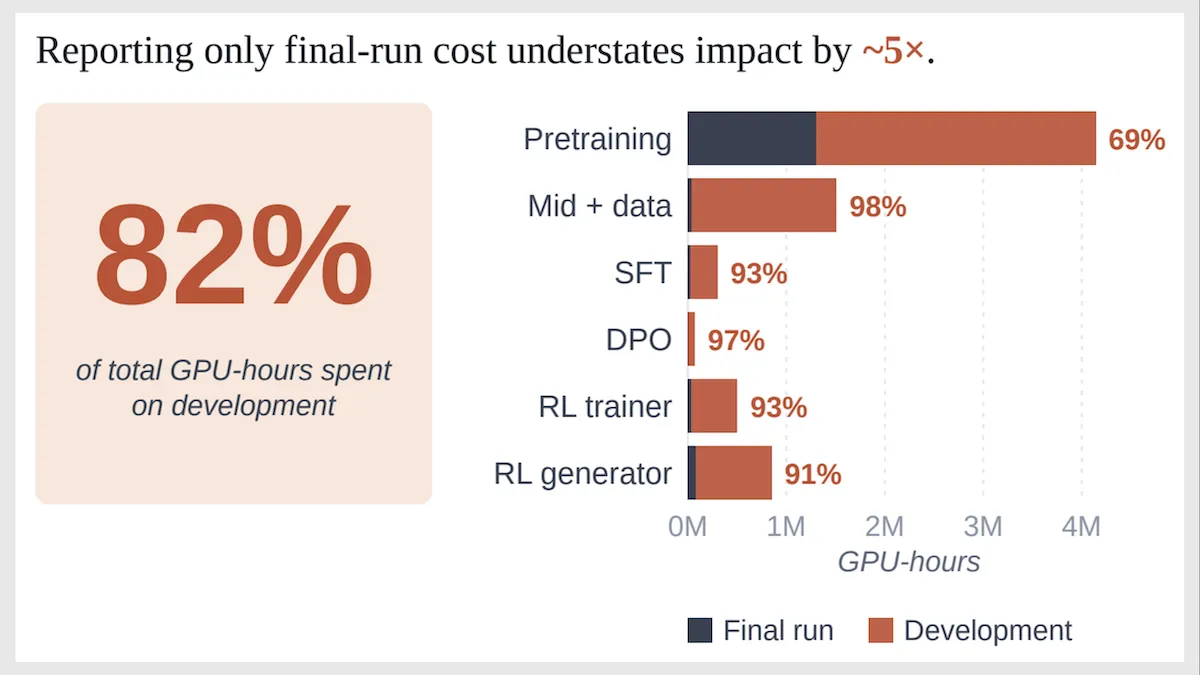
Researchers from the University of Washington, the Allen Institute for AI, and Carnegie Mellon University have conducted a comprehensive environmental audit of the Olmo 3 open-weight model family. Led by Jacob Morrison, Noah A. Smith, and Emma Strubell, the team tracked the energy, carbon, and water footprints across the entire development cycle of Olmo 3 7B, Olmo 3 32B, and their instruction-tuned and reasoning-focused Think variants. By measuring GPU power consumption at sub-second intervals and factoring in auxiliary data center overhead, the researchers calculated that the entire development process consumed approximately 12.3 gigawatt-hours of electricity. This massive energy draw generated roughly 4,250 tons of greenhouse gases and used nearly 16 million liters of water.
The study's most striking revelation is that final training runs represent only a fraction of a model's total ecological cost. When looking at training-related GPU hours, a staggering 82.2 percent went toward preliminary experimentation—such as hyperparameter tuning and ablation studies—while the final training runs accounted for just 17.8 percent. Across the entire development lifecycle, generating synthetic training data was the single largest resource sink, consuming 36.9 percent of all GPU hours. Meanwhile, actual pretraining consumed 30.9 percent, midtraining took 18.8 percent, reinforcement learning used 3.8 percent, supervised fine-tuning required 2.3 percent, and direct preference optimization accounted for a mere 0.5 percent.
The research also highlights the steep environmental premium of reasoning capabilities. Fine-tuning the Olmo 3 32B Think model demanded 14 times more GPU hours than its standard instruction-following counterpart. For practitioners, these findings shift the conversation around sustainable AI. Rather than simply optimizing final training configurations, developers must recognize that the trial-and-error phase of model design is the true environmental bottleneck. As the industry pivots toward complex reasoning architectures that require extensive reinforcement learning and synthetic data pipelines, engineering efficiency during the early experimental stages will become paramount to keeping both carbon footprints and operational budgets in check.
This is our own summary of reporting by The Batch