Talentica Blends RAG and Fine-Tuned Qwen for Support
Talentica Software has developed a hybrid AI architecture combining retrieval-augmented generation with a fine-tuned Qwen model to resolve the trade-offs between factual accuracy and tone.
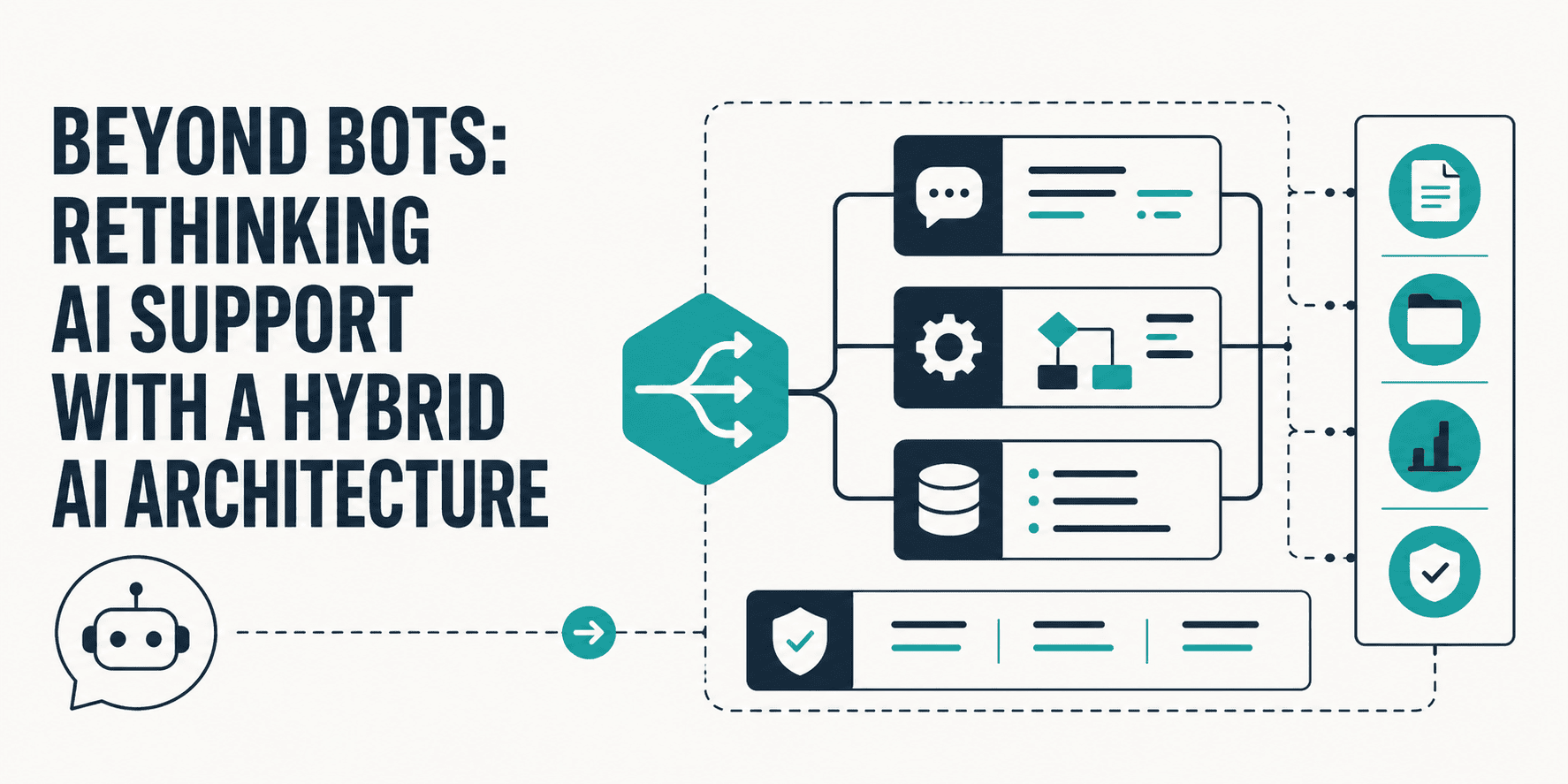
Talentica Software data scientist Alakh Sharma designed a hybrid AI architecture that merges retrieval-augmented generation (RAG) with a fine-tuned Qwen large language model. Built to address the security, latency, and accuracy demands of enterprise customer support, this system aims to prevent hallucinations and maintain brand voice. The development comes as data security remains paramount, with IBM's 2025 report estimating the average global cost of a data breach at $4.44 million.
During development, the team discovered that relying on a single methodology introduced severe trade-offs. In a test chatbot, a RAG-only system had access to nearly 100 percent correct context but achieved only about 70 percent output correctness, suffering from poor tone consistency and high latency. Conversely, fine-tuning the Qwen model on roughly 1,000 expert Q&A pairs using low-rank adaptation (LoRA) adapters boosted tone alignment to approximately 90 percent, but caused factual accuracy to plummet to about 50 percent.
By combining both techniques, the hybrid architecture allowed the fine-tuned Qwen model to dictate how to answer while the RAG system supplied what to answer. This integration yielded a tone accuracy of roughly 75 percent and boosted factual correctness to approximately 73 percent, outperforming both individual methods. Using LoRA adapters also preserved the base model's general knowledge and reduced the GPU memory required for fine-tuning.
For AI practitioners, this hybrid approach demonstrates that expanding context windows is not a cure-all for model limitations like primacy-recency bias. Instead of forcing a single model to handle both information retrieval and behavioral formatting, developers should decouple these tasks. This architecture provides a blueprint for building fast, secure, and controllable domain-specific support systems without incurring the high compute costs of full model fine-tuning.
This is our own summary of reporting by KDnuggets