NVIDIA NeMo Retriever Powers Multimodal RAG Pipelines
A new technical guide demonstrates how developers can build advanced multimodal RAG pipelines using NVIDIA NeMo Retriever to extract, index, and query complex document elements.
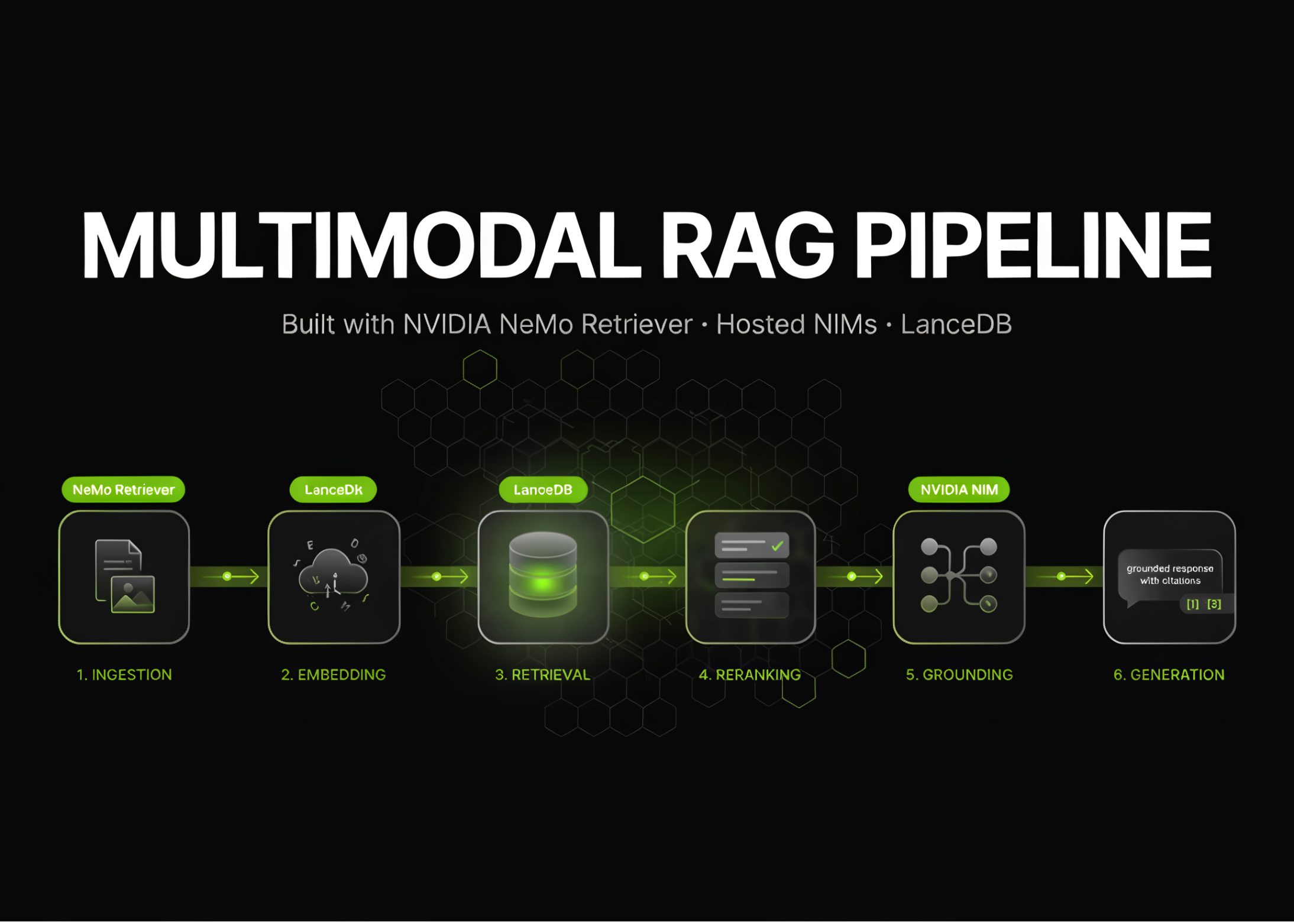
Developers can now construct highly sophisticated multimodal retrieval-augmented generation (RAG) pipelines by combining NVIDIA NeMo Retriever with hosted NVIDIA Inference Microservices (NIMs). A newly detailed implementation workflow shows how to process complex PDF documents containing text, tables, charts, and infographics without requiring local GPU resources for the initial stages. The pipeline relies on a Python 3.12 environment and starts with offline text extraction using PDFium before passing the document to cloud-hosted endpoints.
To ingest and structure the multimodal data, the pipeline coordinates several specialized NIM endpoints. It uses nemotron-page-elements-v3 for layout detection, nemotron-ocr-v1 for optical character recognition, nemotron-table-structure-v1 for table extraction, and nemotron-graphic-elements-v1 for analyzing visual components. The extracted content is split using token-aware chunking with a maximum of 512 tokens and a 64-token overlap. After deduplicating overlapping elements with a bounding-box intersection-over-union threshold of 0.45, the system generates dense vector embeddings using the nvidia/llama-nemotron-embed-1b-v2 model and stores them in a LanceDB table.
For the retrieval and generation phases, the pipeline employs a dense retriever to search the LanceDB index. It refines these results using the nvidia/llama-nemotron-rerank-vl-1b-v2 vision-language model to reorder candidates based on semantic relevance. Finally, the system passes the filtered context to the nvidia/llama-3.3-nemotron-super-49b-v1.5 language model to generate grounded answers complete with inline citations and page numbers.
This architecture changes the game for enterprise practitioners who need to extract knowledge from complex, visually rich documents like financial reports or scientific papers. By offloading heavy model inference to hosted NIM endpoints, developers can run the orchestration layer on lightweight local environments or standard cloud runtimes. The integration of vision-language reranking and metadata-filtered search ensures that the final generation stage remains strictly grounded, minimizing hallucinations and providing verifiable citations for every answer.
This is our own summary of reporting by MarkTechPost