MiniMax updates its AI agent as Mavis.
MiniMax has updated its AI agent as Mavis, introducing a structured multi-agent architecture that offers a highly cost-effective but conditional alternative for complex developer workflows.
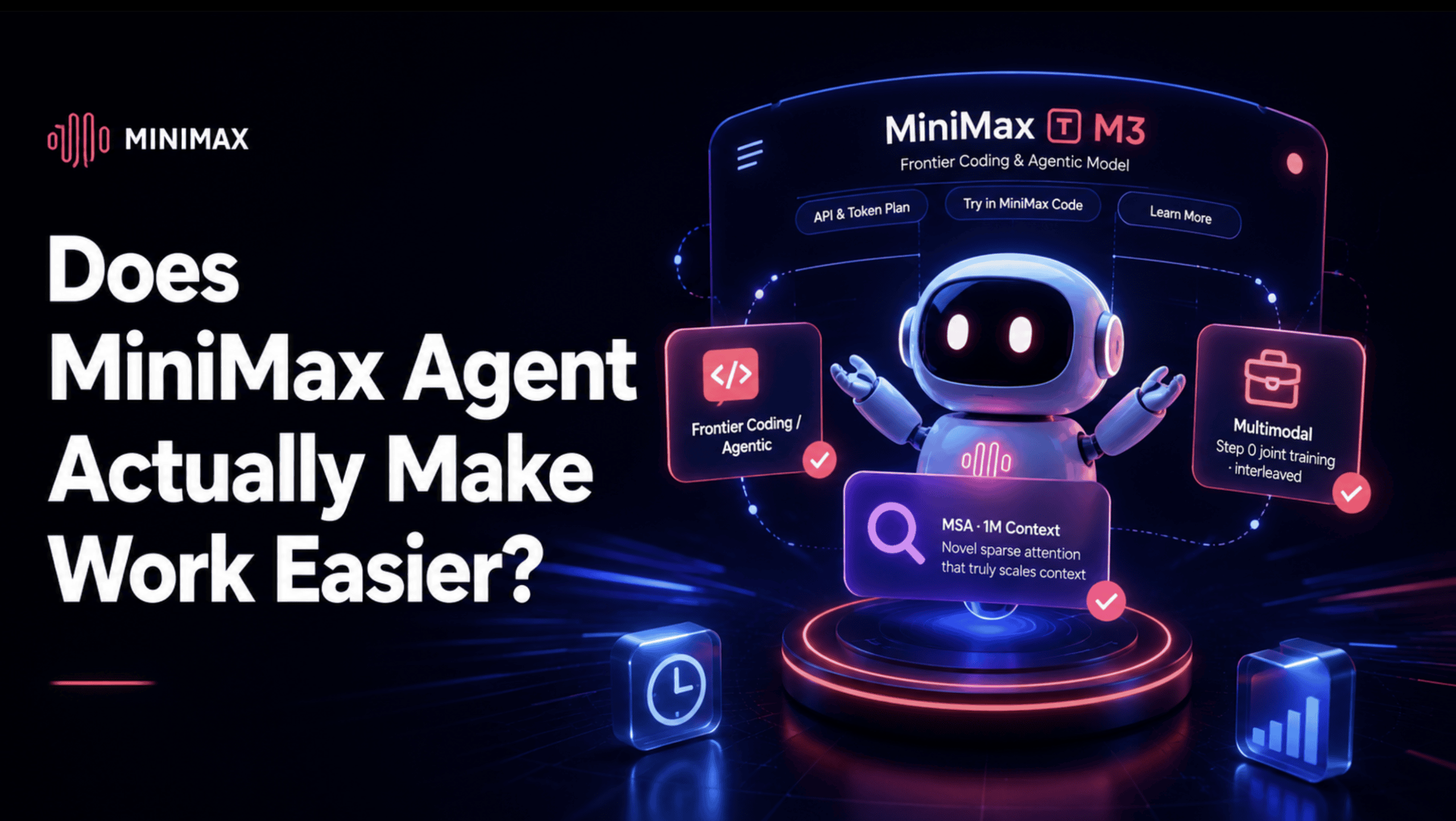
On May 27, 2026, MiniMax rebranded its AI agent as Mavis, short for MiniMax as a Jarvis, and restructured the platform around an Agent Teams framework. This setup divides labor among three distinct roles: a Leader that structures tasks, a Worker that executes them, and a Verifier that checks the output. Alongside this release, the company merged its TokenPlan and Agent Plan subscriptions into a single unified plan. It also highlighted its latest model, M3, which features a sparse attention architecture supporting a 1 million token context window and native multimodal input. This follows the open-weight MiniMax-M2 and M2.5 models, as well as M2.7, which recently had its commercial terms quietly restricted to require written authorization.
For practitioners, the value of this multi-agent architecture is highly conditional. MiniMax's own engineering documentation admits that unstructured multi-agent collaboration can be highly inefficient. Specifically, their cited Cost of Consensus research shows that unstructured debate among homogeneous models can run 2.1 to 3.4 times the token cost of a single agent correcting itself, yielding no accuracy improvements. To combat this and mitigate what MiniMax calls context anxiety—where long-running agents stall to ask users if they should continue—Mavis uses a persistent state machine called the Team Engine to coordinate its structured roles.
From a financial perspective, Mavis is highly competitive. The MiniMax-M3 model is priced at $0.30 per million input tokens and $1.20 per million output tokens on its standard tier, reflecting a promotional 50 percent discount off its $0.60 and $2.40 list prices. Compared to Claude Opus 4.6, which costs $5 per million input tokens and $25 per million output tokens, MiniMax-M3 is roughly 17 times cheaper on input and 21 times cheaper on output. Furthermore, the API is Anthropic-compatible, allowing developers to use standard SDKs simply by changing the base URL. However, teams must weigh these savings against broader risks, including Anthropic's distillation accusations against MiniMax and the Disney, Universal, and WB copyright suit against its video product. Ultimately, this structured system makes work easier only for long, verifiable tasks where parallel processing offsets the overhead.
This is our own summary of reporting by KDnuggets