Hume AI Targets the Listening Problem in Voice Tech
Hume AI is pushing the industry to evaluate voice models on emotional nuance rather than text transcripts, a shift that could make conversational agents truly understand human intent.
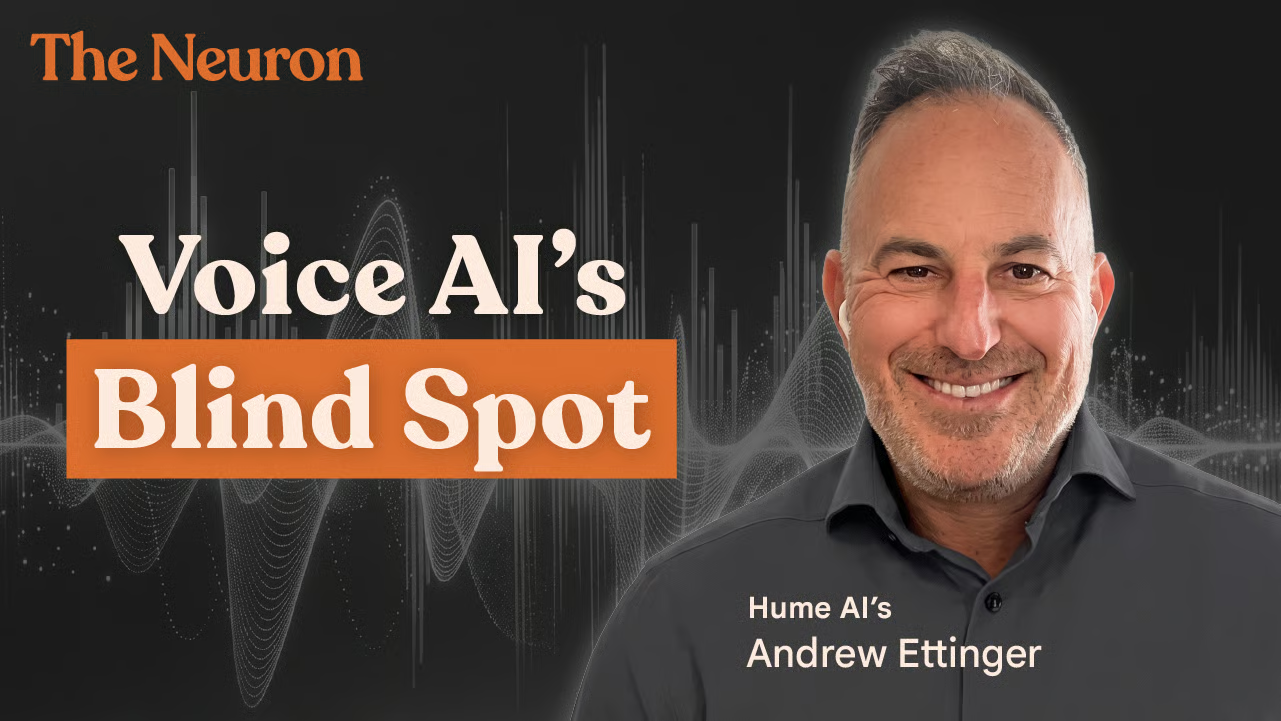
Hume AI chief executive officer Andrew Ettinger argues that modern voice technology suffers from a fundamental limitation. Ettinger notes that voice technology currently has "a listening problem because it just reads the transcript" instead of analyzing acoustic data. When an artificial intelligence agent flattens speech into text, it strips away critical contextual data such as tone, pauses, accents, background noise, and facial expressions. Ettinger points out that a simple phrase like saying one is fine can convey fear, confusion, or annoyance depending on how it is spoken, yet a standard transcript treats these vastly different emotional states identically.
To address this gap, the company is promoting its Real World VoiceEQ benchmark, which evaluates voice systems based on how actual humans experience them. Instead of relying on traditional pronunciation benchmarks or public leaderboards, this framework measures performance across six key dimensions: recognition, expression, emotion, reliability, context, and outcome. This methodology assesses whether a model can detect emotional signals, maintain natural responses over long conversations, and successfully resolve a user's query despite real-world distractions like background noise or interruptions.
For developers and enterprise practitioners, this shift changes how voice agents are built and tested. Relying on public leaderboards is no longer sufficient for deploying voice agents in high-stakes environments like customer support, banking, or healthcare. Ettinger suggests that companies leverage the massive volumes of recorded conversational data sitting in call centers to train and evaluate proprietary voice models. By moving away from flat text analysis, practitioners can build systems that remain reliable over a thirty-minute customer service call rather than just sounding natural for a brief thirty-second demonstration.
This is our own summary of reporting by The Neuron