Databricks launches ai_decide for fast data decisions
Databricks has launched a new AI function called ai_decide in beta, offering a faster and cheaper alternative to large language models for making structured choices on governed data.
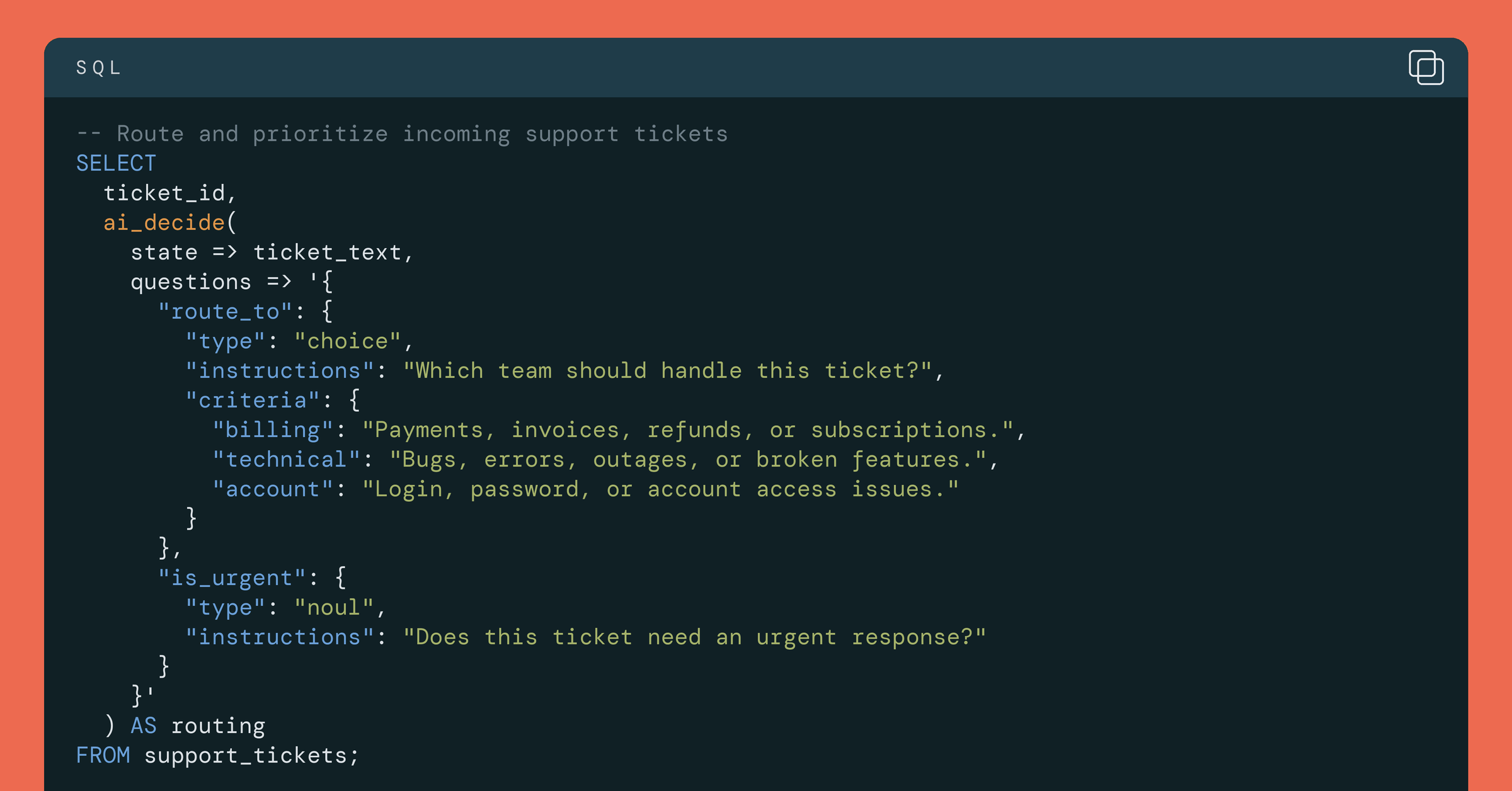
Databricks has introduced a new AI Function called ai_decide, currently available in beta, designed to bypass the high latency and costs associated with using full large language models for simple classification tasks. Instead of generating text, the function relies on a specialized decision model to analyze raw text and output structured determinations in milliseconds. The underlying technology is powered by TypeSafe AI's Jev model, making the function directly compatible with existing TypeSafe AI API workflows.
When processing unstructured input against a set of questions, ai_decide bypasses complex text generation to deliver rapid, structured decisions. For each query, the function outputs either a probability, a choice from predefined criteria, or a score on an ordered scale. Because it is optimized solely for decision-making rather than conversational text generation, it operates at a fraction of the cost of traditional LLMs, making it highly efficient for high-scale enterprise workloads.
Practitioners can deploy ai_decide in two primary ways: via SQL for processing large batches of governed data, or through a REST API for real-time applications and autonomous agents. The tool is suited for tasks like analyzing customer reviews to identify recurring product issues, evaluating the quality of AI-generated answers against corporate policies, or routing user prompts to the most cost-effective model based on difficulty. Databricks even demonstrated its real-time capabilities by using the function to play the game Snake, where the system determined the next move on every tick.
Beyond the managed function, Databricks is supporting a broader ecosystem of open-weight decision models. Users can serve and run these models, such as open-Jev, directly within SQL on the Databricks platform. This flexibility allows data teams to optimize their pipelines by matching the specific reasoning requirements of their workflows to the most efficient model available, avoiding the overhead of general-purpose LLMs.
This is our own summary of reporting by Databricks AI