Microsoft releases Orchard to slash AI agent costs tenfold.
Microsoft Research has released Orchard, an open-source Kubernetes-native framework that slashes AI agent training costs tenfold while matching the performance of proprietary systems.
Microsoft Research has launched Orchard, a free, open-source, Kubernetes-native framework designed to streamline the training and evaluation of AI agents. At its core is Orchard Env, an environment manager that decouples sandbox execution from training pipelines. This design addresses a major bottleneck for developers: the tendency of agents trained on a single harness to collapse when deployed in unseen environments. By offering multi-harness training, Orchard ensures agent performance remains stable across diverse deployment scenarios.
The infrastructure savings are highly significant for developers. Orchard Env achieves an average command-execution latency of 0.28 seconds, which matches SkyPilot Code Sandbox while running 2.7 times faster than E2B and 7.3 times faster than Modal. Financially, running 128 parallel sandboxes for 240 hours on spot instances costs just $673 with Orchard, compared to $7,078 on managed alternatives like Daytona or E2B. This represents a tenfold reduction in operational costs, making large-scale agent training far more accessible.
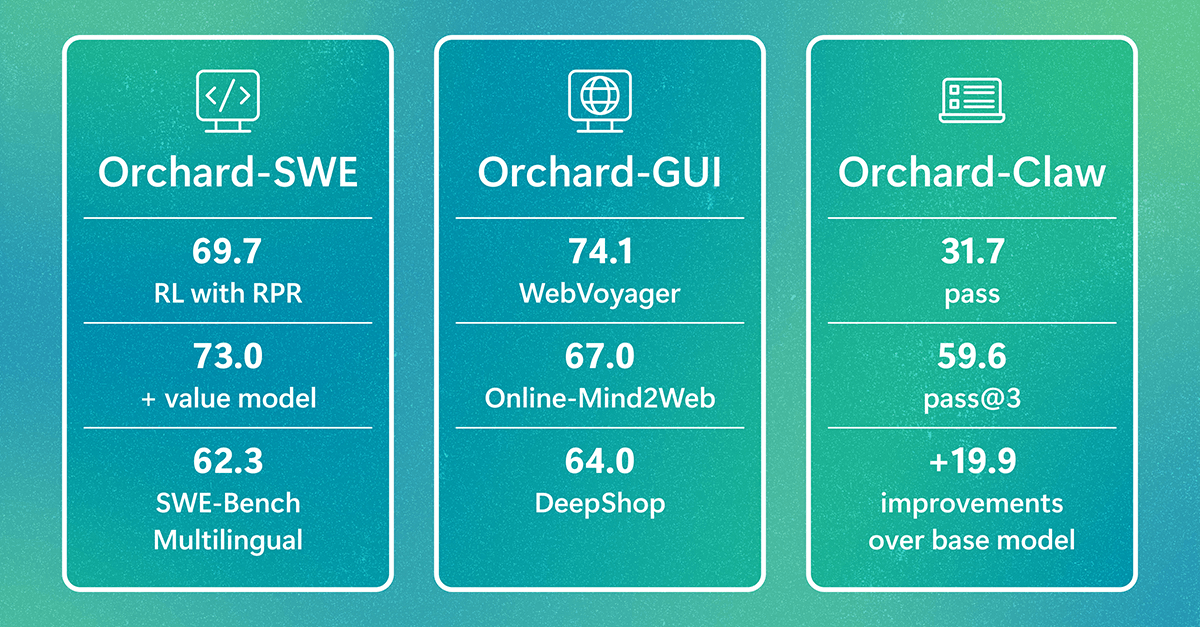
These efficiency gains do not come at the expense of capability. The Orchard-SWE model, which utilizes only about 3 billion active parameters, achieved a 69.7 percent score on SWE-bench Verified, rising to 73 percent with reranking. This performance matches models ten times its size. Additionally, the 4-billion-parameter Orchard-GUI model achieved a 68.4 percent average across WebVoyager, Online-Mind2Web, and DeepShop, establishing itself as a highly competitive open-source browser agent capable of rivaling proprietary computer-use systems from OpenAI and Gemini.
For AI practitioners, Orchard shifts the development landscape by replacing expensive, proprietary scaffolding with a reusable, composable substrate. The full release includes the environment service, training recipes, and a dataset of 107,000 SWE trajectories, which contains failed attempts crucial for credit-assignment training. This allows teams to collect training trajectories, run reinforcement learning rollouts, and conduct evaluations across different harnesses without rebuilding their underlying infrastructure.
This is our own summary of reporting by AlphaSignal