Mistral AI debuts Shieldstral 1.0 3B safety classifier
Mistral AI has launched Shieldstral 1.0 3B, an open-weights safety classifier that lets developers define custom moderation policies on the fly without retraining the model.
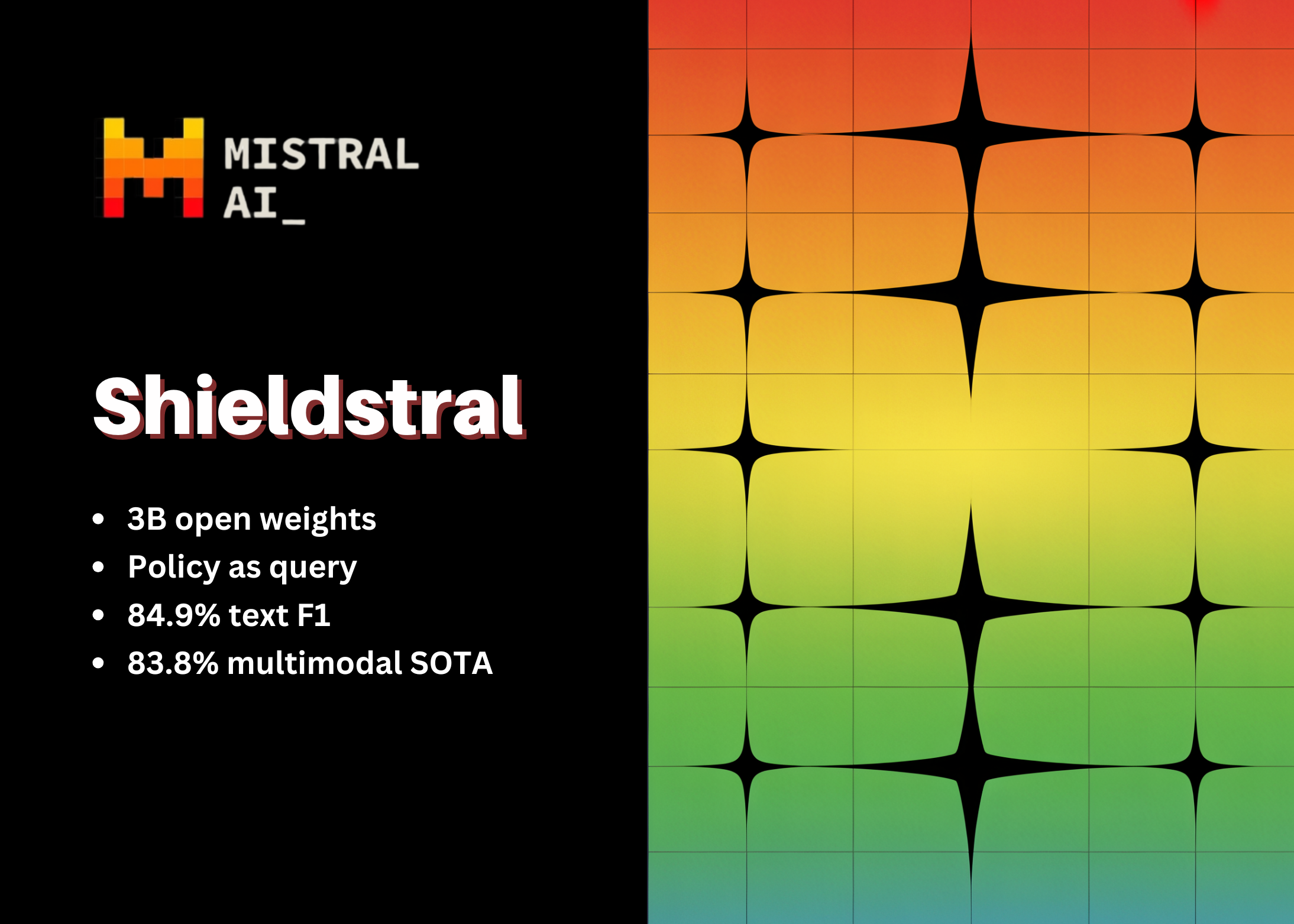
Mistral AI has launched Shieldstral 1.0 3B, a lightweight, open-weights multimodal safety classifier designed to simplify content moderation. Built on the Ministral-3-3B-Base-2512 architecture and featuring a native Pixtral vision encoder, the model is released under the Apache 2.0 license. Unlike traditional guardrails that hardcode safety categories into their weights, Shieldstral processes moderation as a single yes-or-no question. Developers write their specific safety policy in plain language at inference time, and the model evaluates the input in a single forward pass, outputting a continuous safety score thresholded at 0.5.
For practitioners, this architecture drastically reduces latency and operational costs. Shieldstral fits within 16GB of VRAM in BF16 format, allowing it to run locally on a single GPU. It supports deployment via vLLM (version 0.26.0 or higher), SGLang, Transformers, and llama.cpp using Q8_0, Q5_K_M, and Q4_K_M GGUF quantization, with fine-tuning supported through Axolotl. Mistral trained the model on 54.1 million samples, comprising 45.2 million open-source text samples, 4.4 million synthetic contrastive text samples, and 4.5 million multimodal samples. The final model was created using LoRA fine-tuning followed by a three-way SLERP merge consisting of 0.6 public and generated data, 0.3 public-only data, and 0.1 Ministral-3B-Instruct.
Despite its 3B parameter size, Shieldstral matches the performance of much larger systems. On text safety, it achieved an 84.9% average F1 score, tying the 20-billion-parameter GPT-OSS-Safeguard-20B. It scored 84.1 on ToxicChat, 99.4 on HarmBench, and 87.2 on Aegis v2 response. In multimodal safety, it scored 83.8% overall, outperforming OmniGuard-7B at 77.6%, VLGuard at 97.7, and UnsafeBench at 81.8, though LlavaGuard-7B still leads its namesake benchmark at 81.4. On adaptability, Shieldstral reached a 91.3% F1 score, trailing GPT-OSS-Safeguard-20B at 94.1% and Nemotron-3.5-Safety-4B at 91.8%. Its refusal detection landed at 91.5% compared to 93.7% for GPT-OSS-Safeguard-20B.
While highly versatile, Shieldstral has notable limitations. Its multilingual prompt classification struggles with Arabic and Indonesian, scoring 70.3 on RTP-LX prompts compared to 86.1 for Nemotron-3.5-Safety-4B. It also shows reduced reliability on adversarial, obfuscated, or very long inputs, despite supporting a 32k token context window across 12 languages. Nevertheless, its small footprint and open license make it a viable, cost-effective alternative for startups and enterprise teams needing local, customizable guardrails.
This is our own summary of reporting by MarkTechPost