NVIDIA Releases NOOA Python Framework for AI Agents
NVIDIA Labs has open-sourced NOOA, a Python framework that condenses AI agent architectures into a single class to simplify development and slash token consumption.
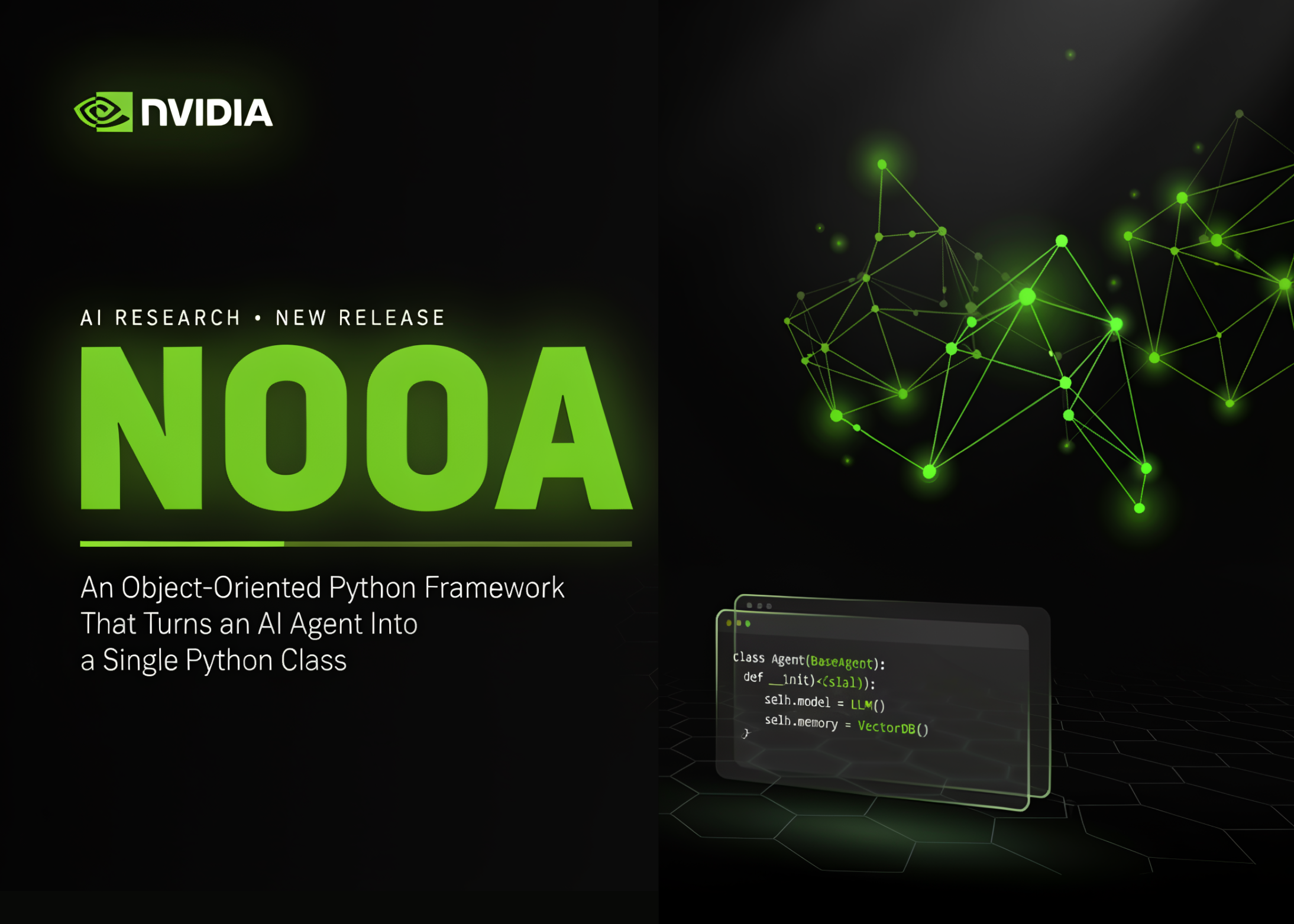
NVIDIA Labs has released NOOA (NVIDIA Object-Oriented Agents), an Apache 2.0-licensed Python framework that simplifies agentic AI development. Currently available as an alpha research preview (v0.0.8, released July 30, 2026), the tool requires Python 3.12–3.13. Instead of splitting agent architectures across prompt templates, tool schemas, and workflow graphs, NOOA consolidates everything into a single Python class. In this framework, fields represent the agent's state, docstrings serve as prompts, and type annotations act as runtime contracts. Methods with an ellipsis body are completed at runtime by an LLM-driven loop, while standard methods remain deterministic Python code.
The framework introduces two execution strategies: PredictStrategy, which uses a single typed LLM call with a local retry loop, and CodeActStrategy, which runs an iterative Python REPL where the model executes code until submitting a validated result. A key feature is pass-by-reference execution, which keeps large data live in the REPL. For example, a 100-element list renders in only about 30 tokens while the full variable remains in the REPL, preserving KV-cache reuse. Additionally, an optional memory subsystem uses SQLite to write and recall records ranked by ACT-R activation.
In capability testing across ten models, NOOA achieved a 97.9% pass rate, solving 4,309 out of 4,400 records. On a 253-line agent configuration, it reached 82.2% on SWE-bench Verified using GPT-5.5 at xhigh effort, outperforming OpenCode at 78.6% and PI at 78.2%. It also achieved 79.8% with Opus 4.6. On Terminal-Bench 2.0, it scored 73.0% at high effort, while on CyberGym L1, it solved 86.8% with network access blocked. For ARC-AGI-3, the framework reached a 50.2% mean RHAE with GPT-5.5 and 85.1% with GPT-5.6-sol, costing under $20 per game.
For practitioners, NOOA offers massive efficiency gains, achieving its 82.2% SWE-bench score using roughly 1.1 million tokens and 28 model calls per task, compared to PI's 2.2 million tokens and 66 calls. Because the framework executes LLM-generated code, developers must run it within OS-level isolation, such as a virtual machine, container, or NVIDIA OpenShell. Pluggable model support is handled through LiteLLM, allowing integration with hosted APIs, vLLM, and Ollama.
This is our own summary of reporting by MarkTechPost