NVIDIA Releases Alpamayo 2 Super Driving Model
NVIDIA has launched Alpamayo 2 Super, a 34-billion-parameter vision-language-action model under an open commercial license to help autonomous vehicles navigate complex, rare driving scenarios.
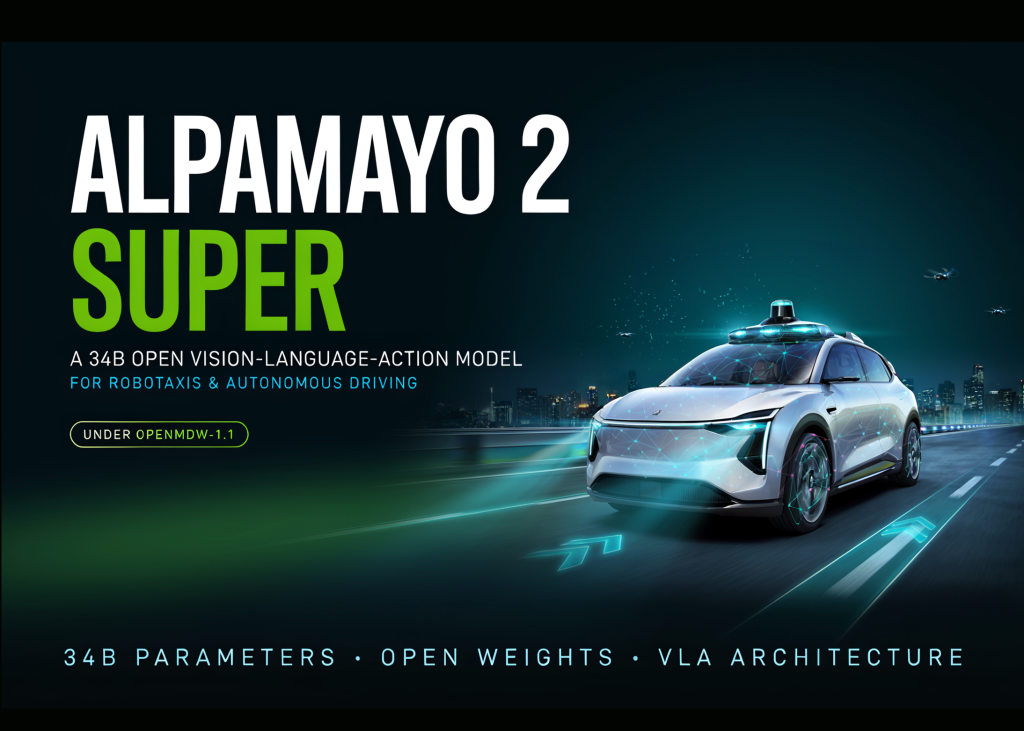
NVIDIA has introduced Alpamayo 2 Super, a 34-billion-parameter vision-language-action (VLA) model designed to improve autonomous driving systems during rare, complex multi-agent scenarios. Released under the permissive OpenMDW-1.1 license for weights and Apache 2.0 for source code, the model is immediately available for commercial deployment, fine-tuning, and redistribution. The architecture combines a 32-billion-parameter Cosmos 3 Super Reasoner backbone, post-trained with reinforcement learning, and a 2.3-billion-parameter diffusion-based action decoder.
The system processes multi-camera RGB video, text, and historical egomotion data to output a planned trajectory, a meta-action like a lane change, and a Chain-of-Causation (CoC) explanation. In a single pass, it generates 64 trajectory waypoints spanning 0.1 to 6.4 seconds. NVIDIA trained the model on over 115,000 hours of multi-camera driving video, 3.7 million CoC traces, and more than one billion images. A validated public notebook configuration utilizes six cameras and four historical frames per camera.
Alpamayo 2 Super achieved a top score of 79.2 on the LingoQA benchmark, outperforming Qwen2.5-VL 72B by 17.0 points, Gemini 2.5 Pro by 15.1 points, and GPT-4o by 23.2 points. In closed-loop testing using AlpaSim on 910 scenarios from the PhysicalAI-AV-NuRec dataset, it scored 1.50 ± 0.13. Open-loop testing on 937 samples from the PhysicalAI-AV dataset yielded a minimum average displacement error (minADE₆) of 0.911 meters at 6.4 seconds.
For autonomous vehicle developers, this release bridges the gap between perception and action by providing explainable decision-making. The generated CoC traces integrate with NVIDIA Halos safety-validation workflows to support ISO/PAS 8800 safety alignment. Additionally, using the model as an autolabeler on proprietary fleet data can compress annotation cycles from months to days. While the cloud-scale model requires 72,115 MiB of peak memory on a single 80GB H100 GPU, developers can distill it for real-time, in-car inference.
This is our own summary of reporting by MarkTechPost