Nvidia launches Spatial-IQ to test 3D spatial reasoning
NVIDIA Research has launched Spatial-IQ, a diagnostic benchmark exposing why top AI models fail at 3D spatial reasoning and showing how hierarchical training can dramatically boost performance.
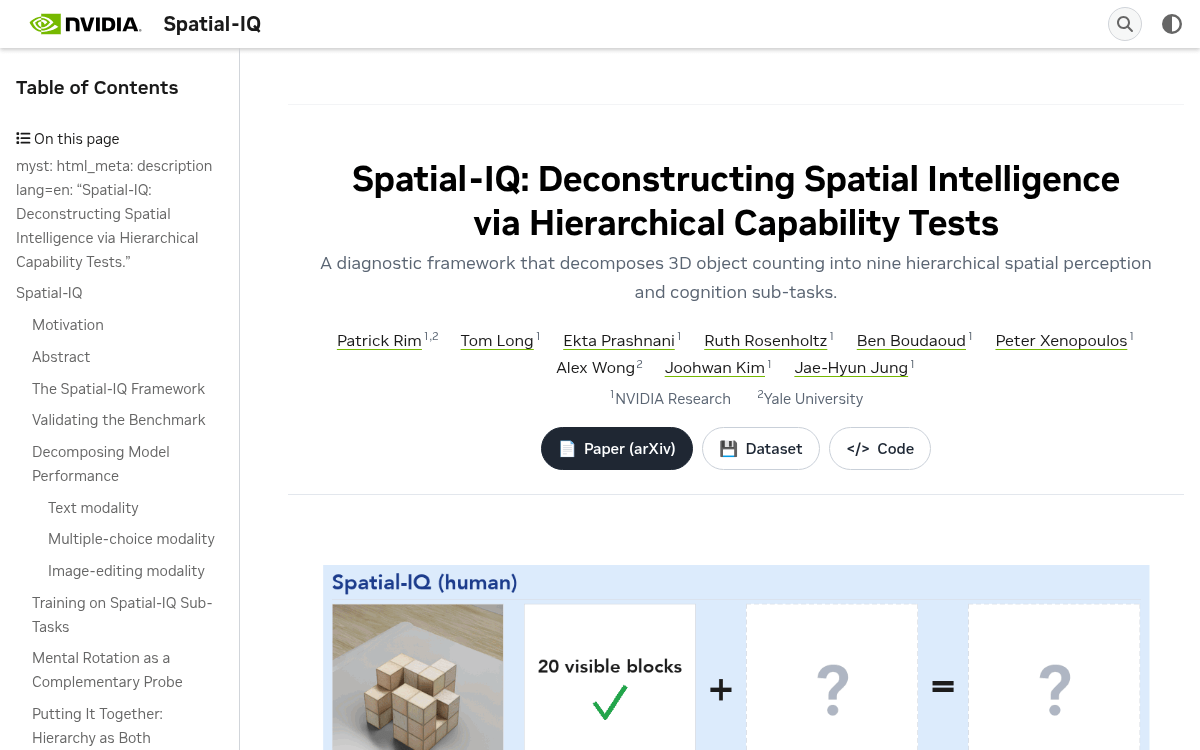
NVIDIA Research has introduced Spatial-IQ, a diagnostic benchmark designed to evaluate and improve 3D spatial reasoning in artificial intelligence. While humans achieve an accuracy of 82.1% when counting stacked 3D objects, the highest-performing vision-language model, Qwen, manages just 17.7%. The benchmark reveals that when AI models do arrive at the correct answer, they often rely on superficial shortcuts rather than actual spatial reasoning. To address this, Spatial-IQ breaks down 3D object counting into nine hierarchical perceptual and cognitive sub-tasks based on human developmental psychology.
The benchmark utilizes a procedurally generated dataset of approximately 80,000 stacked 3D structures created using NVIDIA Isaac Sim. By testing models across these nine distinct stages—such as identifying visible objects and inferring hidden geometry—researchers can pinpoint whether a model fails due to visual perception or cognitive reasoning. This hierarchical structure also serves as a powerful training signal. In testing, NVIDIA researchers fine-tuned the Qwen2.5-VL-32B model using a hierarchical chain-of-thought approach combined with reinforcement learning. This training method caused the model's accuracy to skyrocket from a baseline of 2.9% to 62.6%.
For AI practitioners and robotics developers, Spatial-IQ shifts the paradigm of how vision-language models are evaluated and trained. Instead of treating models as black boxes and relying on single-score accuracy metrics, developers can now diagnose specific failure points in spatial understanding. The open-source release of the dataset, code, and paper on Hugging Face and GitHub allows engineers to implement hierarchical training pipelines. This ensures that models deployed in physical environments, such as robotics and logistics, learn genuine composition and physical reasoning rather than exploiting statistical shortcuts.
This is our own summary of reporting by AlphaSignal