OpenAI upgrades GPT-5.6 Sol, limits free users to Luna
OpenAI has upgraded its GPT-5.6 Sol model for paying ChatGPT users while restricting free tier accounts to the smaller, more error-prone GPT-5.6 Luna model.

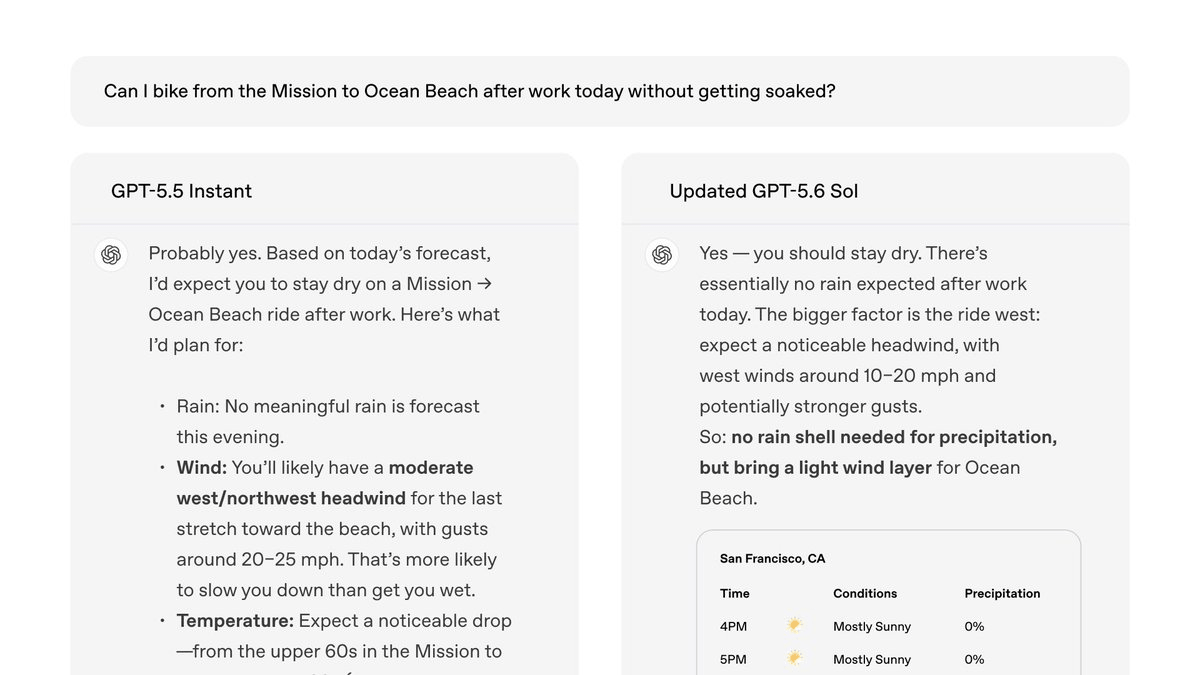
OpenAI has rolled out an update to ChatGPT that refines the GPT-5.6 Sol model for Plus and Pro subscribers while transitioning free and Go tier users to the smaller GPT-5.6 Luna model. For paying subscribers, the upgraded GPT-5.6 Sol has been tuned to reduce redundant formatting and unnecessary details, delivering concise answers for straightforward queries and structured, actionable advice for complex prompts. Additionally, paying users on web, mobile, and desktop platforms can now use a slider to adjust the model's reasoning depth across five distinct settings—a feature previously restricted to ChatGPT Work.
According to OpenAI's internal evaluations across financial, medical, and legal prompts, the update significantly boosts factual accuracy. Compared to the older GPT-5.5 Instant model, responses containing at least one factual error dropped by approximately 62 percent for GPT-5.6 Luna and 68 percent for GPT-5.6 Sol, though these figures have not been independently verified. Notably, this update is exclusive to ChatGPT; GPT-5.6 Sol remains unchanged in Codex and ChatGPT Work.
For free and Go users, GPT-5.6 Luna becomes the default model this week. While they will receive unlimited text chats and a new Think button next week to extend Luna's reasoning time, restrictions on image generation, file uploads, and other advanced tools will remain. This shift represents a double-edged sword for practitioners. While paying users gain granular control over reasoning budgets, free users lose access to OpenAI's top-tier reasoning capabilities entirely. Because the Think button merely allows the smaller Luna model to process longer rather than upgrading the underlying model, users face higher risks of errors. Smaller models are historically less reliable, as seen when the previous GPT-5.5 Instant model generated entirely incorrect data analyses compared to its larger counterparts.
This is our own summary of reporting by The Decoder