OpenAI rebuilds ChatGPT Voice with GPT-Live.
OpenAI has rebuilt ChatGPT Voice with GPT-Live, a full-duplex system that allows simultaneous listening and speaking to create a more natural conversational experience for users.
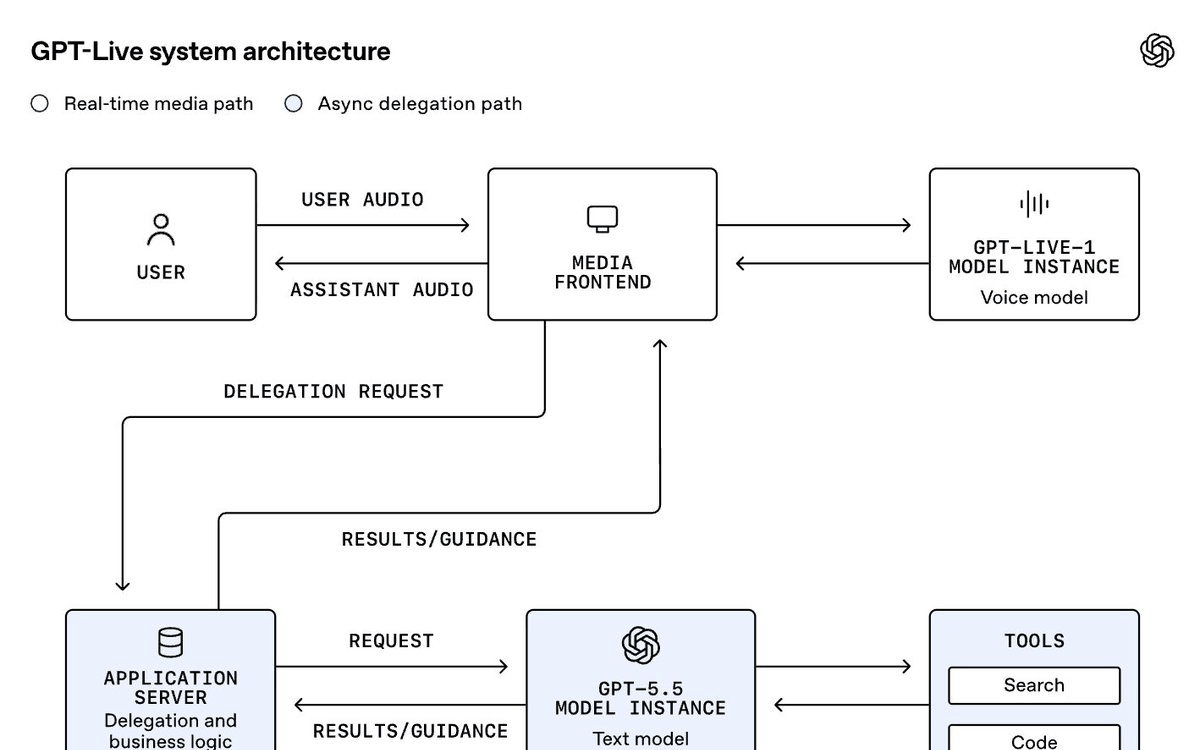
OpenAI has overhauled its voice technology with the launch of GPT-Live, a third-generation voice system designed to support full-duplex audio. Unlike previous iterations that relied on discrete turn-taking and silence-based turn detectors, this new architecture allows ChatGPT to listen and speak at the same time. The system splits tasks between two models: a lightweight voice model that manages the immediate flow of conversation, and GPT-5.5, which runs asynchronously in the background to handle complex reasoning and web searches.
To achieve this seamless interaction for its 150 million weekly voice users, OpenAI engineered several infrastructure upgrades. They created and open-sourced WARP, a new WebRTC extension submitted to the IETF that reduces session startup times from six network round trips down to just one. Additionally, the system utilizes stateful inference with seamless handoffs, allowing context compaction and transitions between model instances to occur without interrupting the active audio stream.
Currently, the GPT-Live-1 mini model is available to users for free, while the full GPT-Live-1 model requires a subscription to the Go tier, which costs $8/mo, or higher. Developers cannot access these features yet, as API access is currently unavailable. Furthermore, the initial launch does not support video or screen sharing, meaning users requiring those capabilities must temporarily rely on the legacy Advanced Voice Mode.
For AI practitioners, this shift from turn-based to continuous inference represents a significant leap in conversational design. By processing inputs continuously, the system can make interaction decisions multiple times per second, enabling features like real-time translation and natural verbal acknowledgments such as "mhmm" mid-sentence. This decoupling of the voice layer from heavy reasoning models demonstrates a viable blueprint for building highly responsive, low-latency agentic voice interfaces at scale.
This is our own summary of reporting by AlphaSignal