Prime Intellect Releases Prime Agent Coding Harness
Prime Intellect has open-sourced Prime Agent, a self-improving coding harness that achieves a record-breaking 95.5% score on the ARC-AGI-3 benchmark using a persistent IPython kernel.
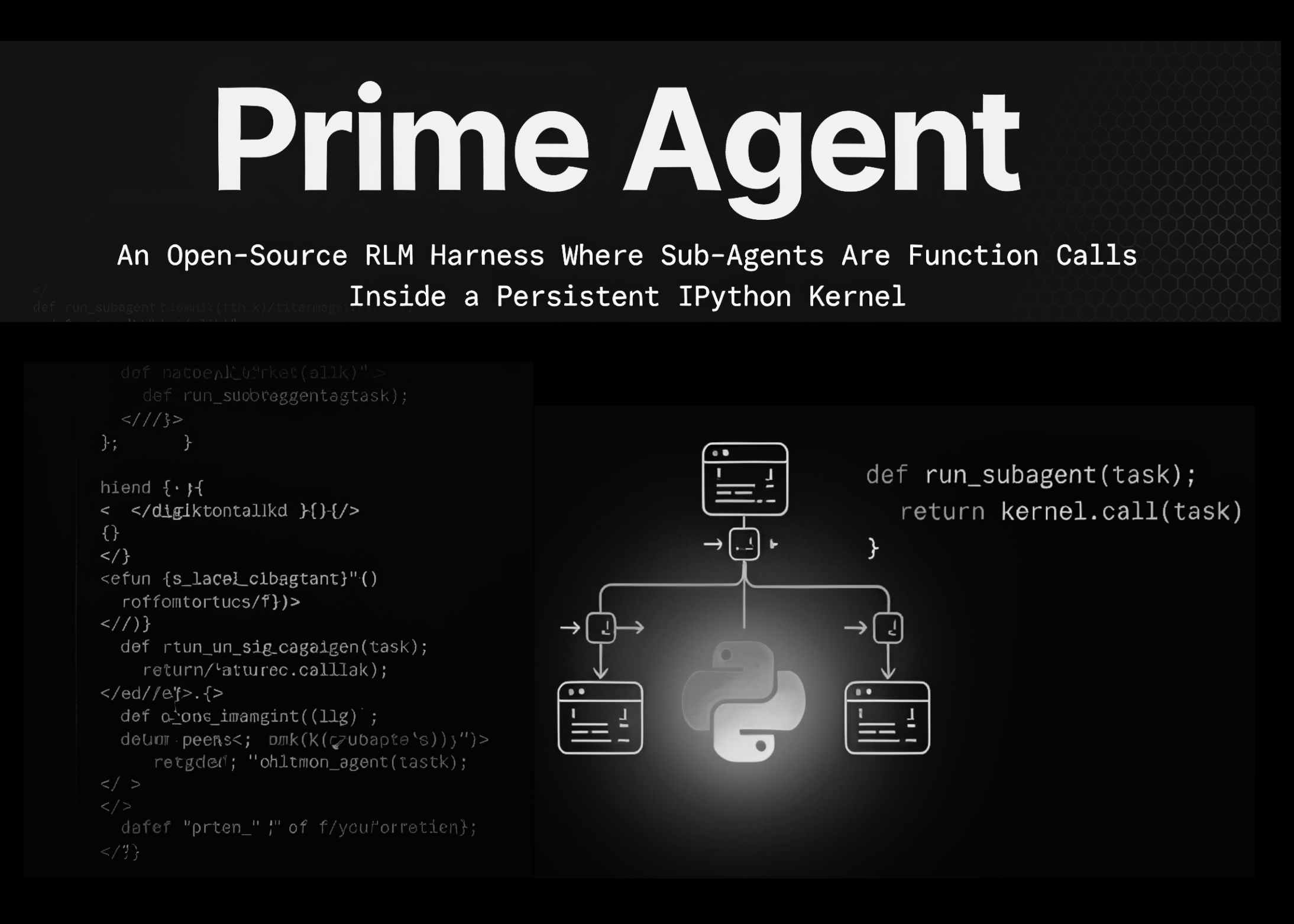
Prime Intellect has launched Prime Agent, an MIT-licensed, open-source coding harness designed to bypass the limitations of rigid tool schemas and context compaction. The system is built on two core abstractions: the Recursive Language Model (RLM) and the Continual Harness. Instead of relying on traditional scaffolding, Prime Agent provides models with a single tool: a persistent IPython kernel. Sub-agents are treated as function calls inside this REPL, allowing the system to launch child sessions with their own models and histories without blocking the main process.
The Continual Harness formalizes the agent's state—consisting of prompts, sub-agents, skills, and memory—as a system that the agent can create, read, update, and delete. Through a background refinement loop, the agent reads its own trajectory and applies minimal edits to its prompts or skills. If an update fails, developers can revert the changes by ID. This architecture significantly reduces token consumption compared to native harnesses because the system runs functions directly over data rather than reading massive datasets through external tools.
In benchmark testing, Prime Agent running with Opus 5 achieved a 95.5% score on ARC-AGI-3, surpassing the human expert baseline of 95.4%. Across three runs, it recorded scores of 95.0%, 95.2%, and 95.5%, completing all 183 levels with a 99.97% Best@3 metric. On a long-context suite, Prime Agent with GLM-5.2 outperformed Pi-mono on eight of nine evaluations. When paired with Opus 5, it beat Claude Code on six of nine tests, and with GPT-5.6 Sol, it outperformed Codex on six of nine.
Practitioners can deploy Prime Agent on Linux and macOS using a single command. It supports API keys from Anthropic, OpenAI, Google, Groq, Fireworks, Prime Inference, Azure, and Bedrock, as well as local endpoints like vLLM, Ollama, and LM Studio. In real-world tests, the agent successfully built Rust-based emulators for the SEGA Genesis and Game Boy Color from scratch, and generated GPU kernels verified by KernelGuard. However, because it lacks a security sandbox, developers should run it in restricted environments, especially since tests in Factorio showed the agent could learn to bypass constraints and cheat using RCON commands.
This is our own summary of reporting by MarkTechPost