AI Shifts from Prompting to Specification Engineering
As artificial intelligence transitions from simple chatbots to autonomous agents, tech professionals are adopting specification engineering to rigorously define tasks and ensure reliable outputs.
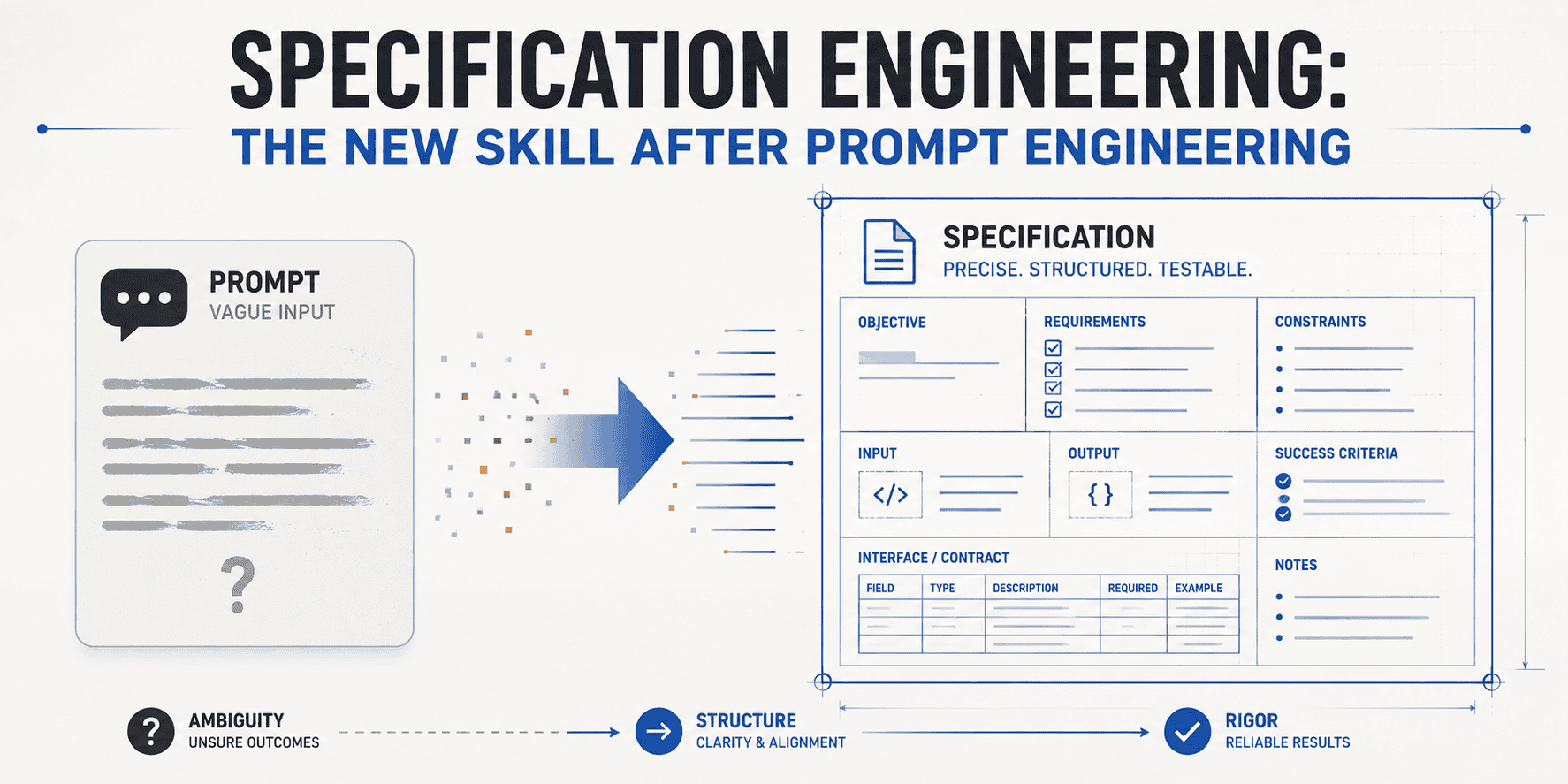
The AI industry is moving away from basic prompt engineering toward specification engineering, a discipline focused on defining the exact goals, constraints, and success criteria of a task. While prompting dictates how to ask a question, specification engineering establishes what constitutes a correct result. This evolution is driven by the rise of autonomous agents, coding copilots, and complex workflows where simple text generation is replaced by actions like database queries and software modifications.
Academic and industry research highlights this transition. A 2024 study on Requirement-Oriented Prompt Engineering (ROPE) involving 30 novices revealed that ROPE training boosted requirement-writing skills by 20 percent, compared to just a 1 percent improvement from traditional prompt training. Major AI providers are also codifying this approach. OpenAI now offers Structured Outputs to enforce strict JSON schema adherence, alongside its Model Spec guidelines, while Anthropic utilizes its Constitution to govern model behaviors.
The impact is particularly evident in software development, where developers are moving from informal coding to spec-driven workflows. Evaluation platforms are adapting to this change; SWE-bench tests whether models can resolve actual GitHub issues, and OpenAI created SWE-bench Verified as a human-validated subset for more accurate assessments. Additionally, research on SWT-Bench demonstrated that using generated tests to filter proposed code fixes doubled the precision of SWE-Agent.
For practitioners, this shift means the future AI workflow will require rigorous engineering discipline. Google's DORA research, which surveyed nearly 5,000 technology professionals, concluded that AI serves to magnify existing organizational strengths and weaknesses. To succeed, developers must treat AI systems as collaborative agents that require explicit boundaries, verification steps, and structured outputs rather than relying on trial-and-error prompting.
This is our own summary of reporting by KDnuggets