Model Context Protocol 2.0 simplifies LLM tools
The release of the stateless Model Context Protocol 2.0 specification simplifies LLM tool integration, prompting developers to build new lightweight clients and database plugins.
The release of the stateless Model Context Protocol (MCP) 2.0, formally known as the 2026-07-28 specification, marks a major evolution for the standard first introduced by Anthropic in November 2024. After a surge of interest in 2025, the protocol faced competition from alternative agent frameworks. However, this new stateless update, first previewed in a May 21st release candidate and highlighted in a 31st July 2026 announcement, drastically reduces implementation complexity by replacing the legacy two-step HTTP session initialization with a single, stateless HTTP request.
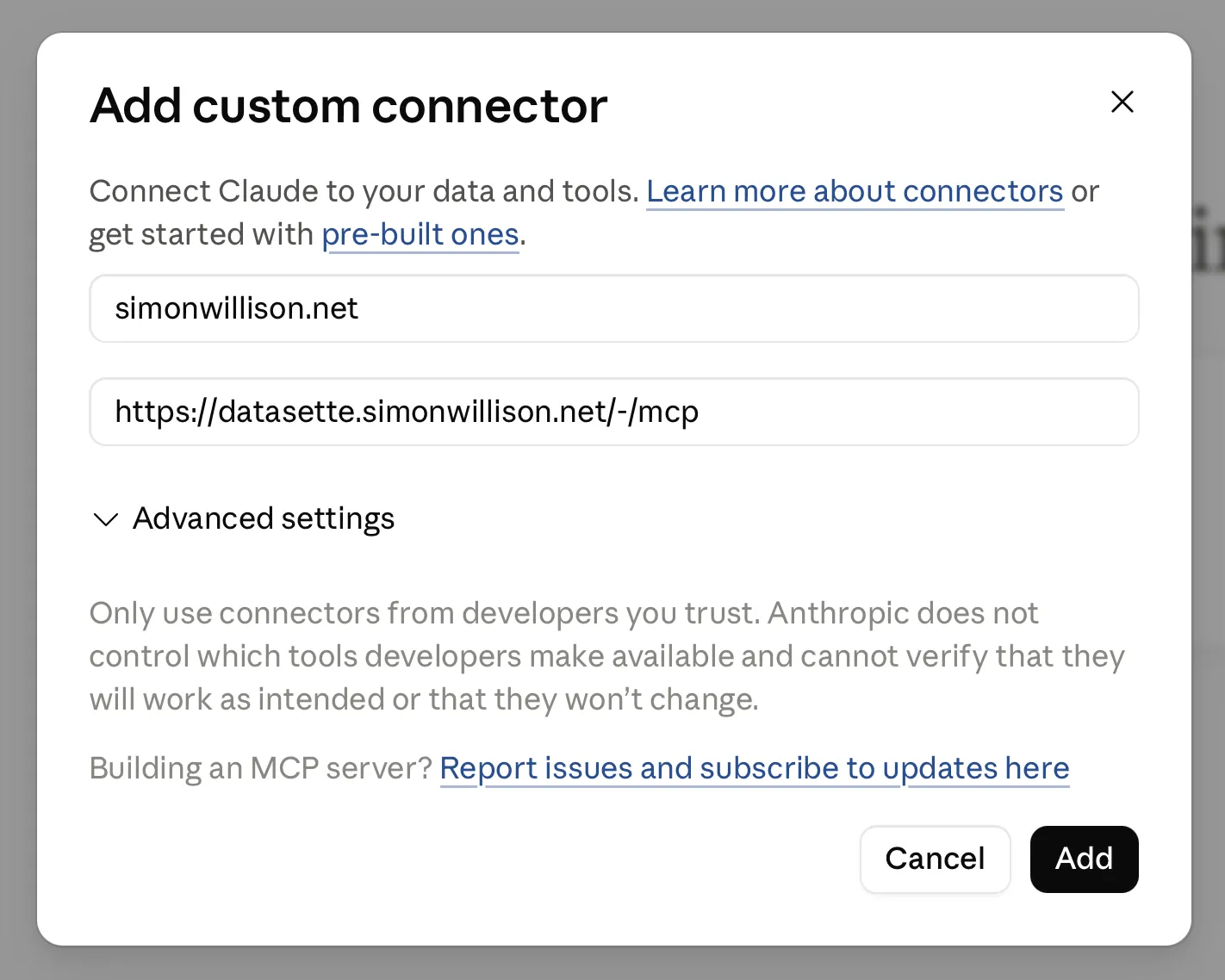
This shift has inspired developers to build new lightweight integrations. Developer Simon Willison created three projects in a single week, starting with mcp-explorer, a stateless Python CLI tool designed to interactively probe MCP servers. He also released datasette-mcp, a plugin that exposes a /-/mcp endpoint on Datasette instances. This plugin provides exactly three tools: list_databases(), get_database_schema(database_name), and execute_sql(database_name, sql). In testing, Claude ran 7 separate SQL queries to answer a user prompt through this interface.
Additionally, the alpha llm-mcp-client plugin brings this capability to the LLM CLI tool, tested using LLM 0.32rc2. For practitioners, stateless MCP 2.0 represents a significant shift in how LLM agents are secured and scaled compared to general environments running advanced models like Claude Fable 5. While giving agents full terminal and curl access is highly risky, MCP tools are far easier to audit and restrict. Because the protocol is now stateless, developers no longer need to manage server-side session IDs or route traffic to specific backend machines, making it highly scalable for production web applications and compatible with smaller models running locally.
This is our own summary of reporting by Simon Willison